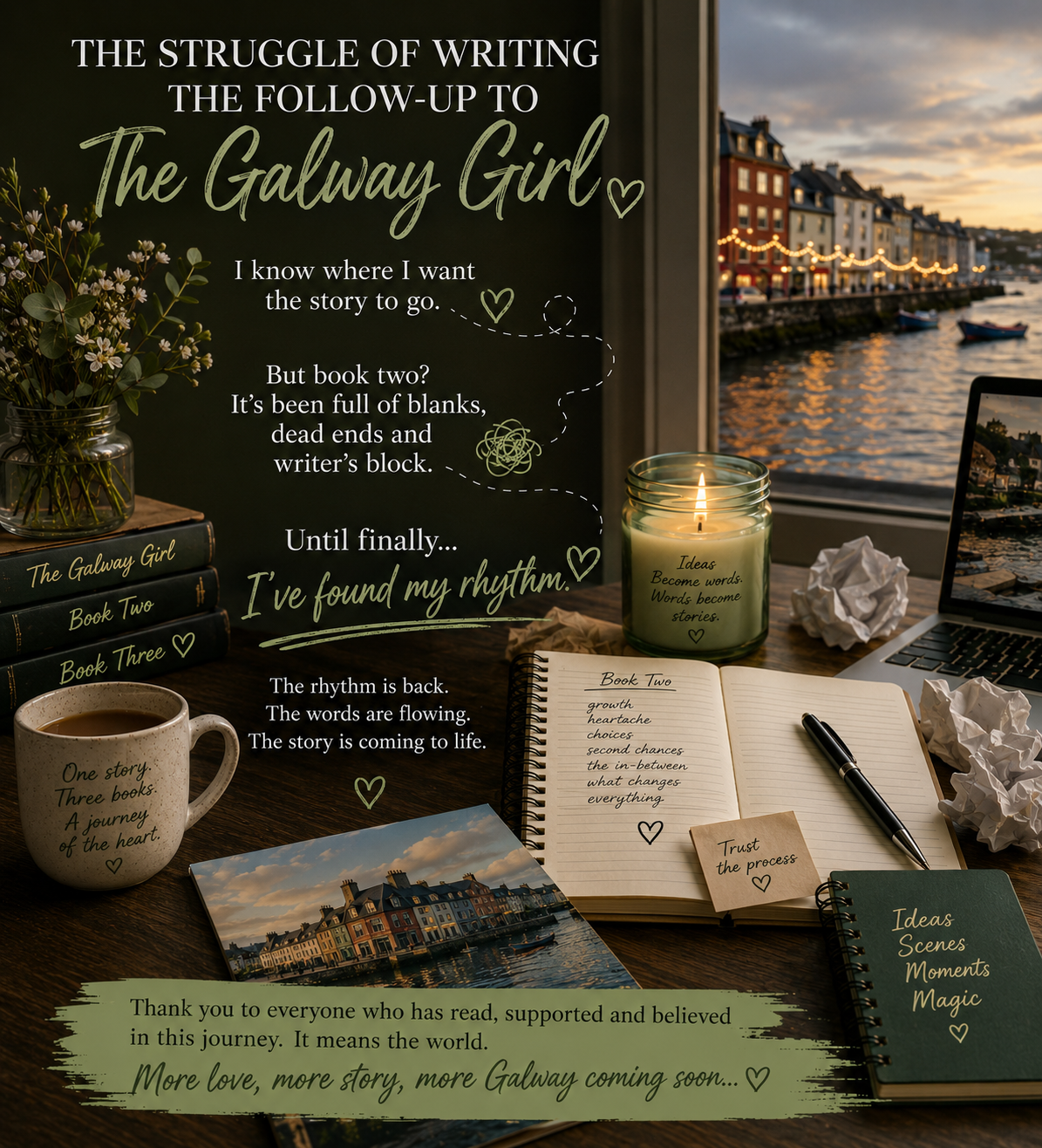
If you’ve ever tried to write a sequel, you’ll know this strange truth: finishing the first book is only half the battle.
When I wrote The Galway Girl, the story poured out with that rare kind of clarity—characters who felt alive from the first page, a setting that carried its own music, and an emotional thread I could follow even when I wasn’t sure where it would lead. I knew what I wanted to say. I knew what the book was.
Then came the follow-up… and suddenly everything got harder.
Knowing the story isn’t the same as knowing the book
Here’s the part I didn’t fully expect: I know where I want the story to go. I can see the emotional arc. I know what the characters need to learn, what they need to lose, what they need to earn. I even know what I want book three to be—its shape, its theme, the way it should land.
But book two? Book two has been the one that asked me to prove it.
Because the follow-up isn’t just “more of the same.” It has to carry the heart of the first book while also deepening everything: the relationships, the stakes, the consequences. It has to honour what readers fell in love with, without repeating the beats they’ve already seen.
And in my case, it has meant staring at scenes I can almost hear… and still not being able to write the next line.
The curse of the blank spaces
The hardest moments haven’t been the big plot points. Those are solid. Those are the “I can see it like a film” parts.
The struggle has been the blanks—the connective tissue that turns an outline into a living novel:
- How do we get from this emotional moment to that one without it feeling forced?
- What needs to happen quietly in-between the fireworks?
- Which conversation changes everything, even though it looks ordinary on the surface?
- How do I show growth without announcing it?
- How do I keep the pace moving when the characters need time to breathe?
Those gaps can look small on paper, but they can stop you in your tracks. And when they do, it doesn’t matter how well you know the ending—you still can’t reach it.
Writer’s block isn’t laziness. It’s friction.
I’ve learned to stop calling it “writer’s block” like it’s some dramatic curse and start calling it what it often is: friction.
Friction between what you want the book to be, and what it currently is on the page.
Friction between the pressure you put on yourself and the reality of creating something from nothing.
Friction between loving your characters and being the one who has to put them through the hard bits.
With a sequel, that friction gets louder, because the first book has already set the bar. You’re not writing into emptiness anymore—you’re writing into expectation. Your own, and everyone else’s.
The breakthrough: finding the rhythm again
The good news is this: I’ve finally had a breakthrough.
Not in the dramatic, lightning-bolt way people imagine. More like a door quietly opening after weeks of pushing on the wrong wall.
It happened when I stopped trying to write the “perfect” version of the sequel and went back to writing the true version. The one that sounds like me. The one that lets the characters speak without me tightening the reins.
And once I found it, I felt it immediately—that rhythm I had in book one.
The sentences started to flow. Scenes that felt impossible suddenly had shape. The blanks didn’t vanish overnight, but they stopped feeling like cliffs and started feeling like stepping stones.
What I’m taking from the struggle
I wish I could say the struggle was wasted time, but I don’t think it was. It taught me things I needed to learn before I could write this book properly:
- Sequels demand patience. You can’t rush emotional truth.
- Sometimes you’re not blocked—you’re protecting the story until you’re ready to do it justice.
- The rhythm isn’t something you force. It’s something you return to.
- And the hardest part of writing isn’t getting ideas… it’s building the bridge between them.
What comes next
Now that the engine is running again, I’m excited—properly excited—to get back into this world.
Because I don’t just want to write a follow-up. I want to write the follow-up The Galway Girl deserves. The one that takes everything readers loved—heart, nostalgia, first-love ache—and pushes it into something deeper: the reality of growing up, looking back, and choosing who you’re going to be next.
And book three? That vision is still there, waiting down the line like a light you can see in the distance.
The difference is, now I’ve found the road again.
#TheGalwayGirl #WritingLife #AmWriting #AmWritingRomance #WriterTok #AuthorLife #IndieAuthor #SequelWriting #WritingASequel #WritersBlock #WritingBreakthrough #CreativeProcess #RomanceAuthor #ComingOfAge #BookBlog #BehindTheScenes #WritingJourney #UKAuthor #IrishRomance #BookSeries


Leave a Reply