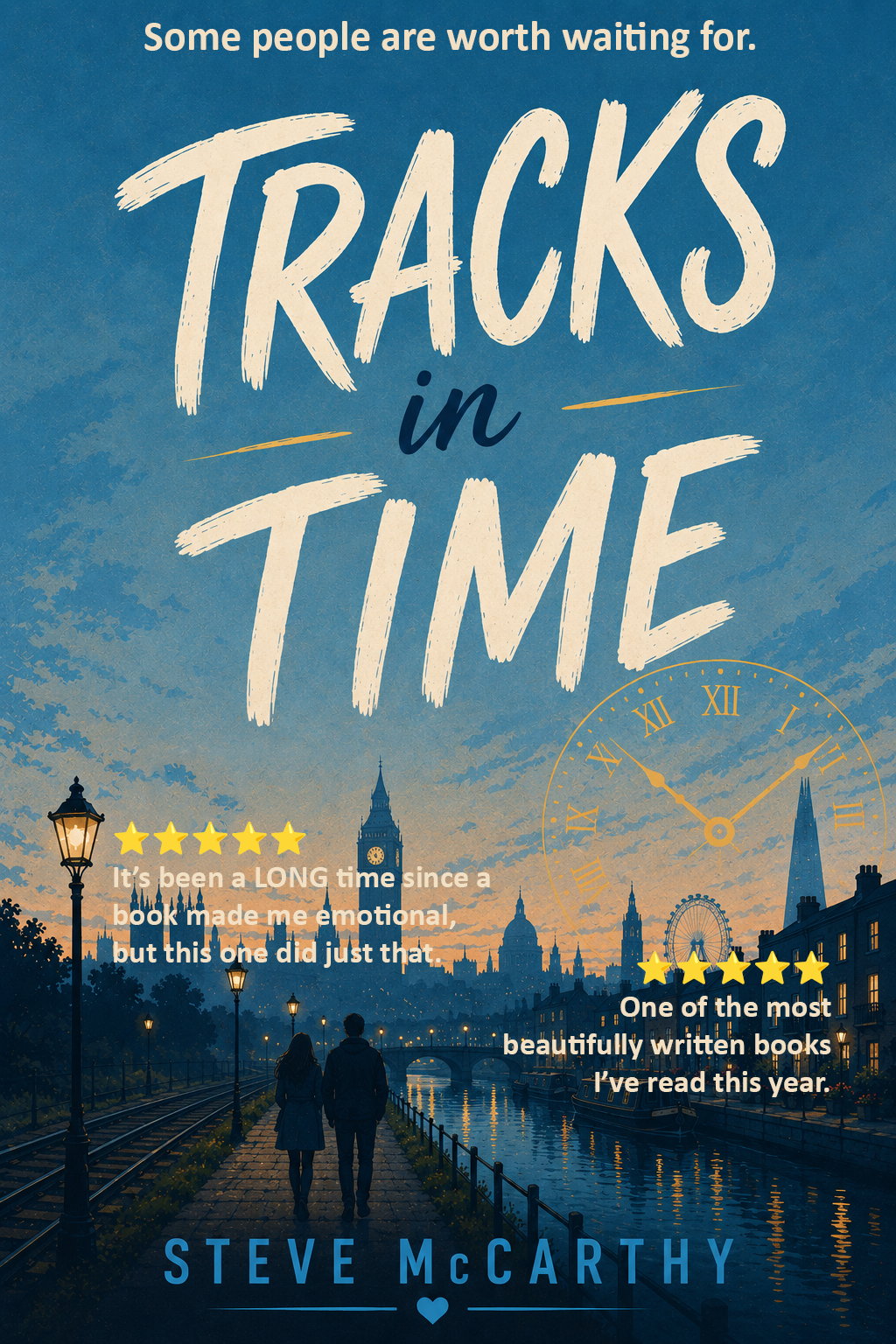
After writing about why I created The Light Between Us, it feels only right to follow up with the book that came from an even closer place.
Because Tracks in Time isn’t just a story I imagined. It’s a story I recognised.
This is my most personal book, and that’s not a line I use lightly. The heart of it is fiction, but the emotional truth running through it is real. Most of the callbacks in the book are inspired by actual events and actual situations I’ve faced—the kind of moments that don’t always look dramatic from the outside, but stay with you for years.
The inspiration: how the past keeps tapping you on the shoulder
I’ve always been fascinated by the way the past doesn’t stay neatly in the past.
A place you haven’t visited in years can bring a memory back with full force. A song can take you straight to a particular night. A smell can drop you into a moment you thought you’d forgotten. Time moves forward, but emotionally we’re always carrying little echoes of what came before.
That’s where Tracks in Time began: with the question of what happens when those echoes get louder.
Not in a big, Hollywood twist kind of way—more in the quiet, human way. The “what if” that creeps in when life goes quiet. The sudden flash of a memory when you’re doing something ordinary. The thought you didn’t invite, but can’t ignore.
Why I used the name Linda again
One of the most personal choices I made while writing Tracks in Time was using the name Linda again.
To be clear: this is a different Linda to the one in The Light Between Us. But I chose the name intentionally because, in real life, it represents something I suspect a lot of us understand without needing it explained: the feeling of a missed opportunity.
We all have those moments we replay. The conversation we didn’t have. The chance we didn’t take. The timing that was slightly off. The person we wonder about years later, not necessarily because they were “the one,” but because we never got to find out who they could have been in our lives.
Using the name Linda was my way of writing into that feeling. Not rewriting the past—just acknowledging that it leaves a mark.
The callbacks: built from real moments
A lot of what gives Tracks in Time its emotional weight comes from the small moments—the things that don’t sound important until you realise how long you’ve been carrying them.
That’s why the callbacks matter so much in this book. They mirror the way memory works in real life: it isn’t a straight line, it’s a pattern. A set of repeating themes. Certain moments looping back when you least expect them.
And because so many of those callbacks are inspired by real events and real situations I’ve experienced, writing them felt strangely exposing. Not because I was telling my life story, but because I was admitting what had stayed with me.
Yes… the pen incident is real
And then there’s the pen incident.
I can confirm: it’s real.
I won’t spoil it here, because if you’ve read the book you’ll know exactly what I mean, and if you haven’t, I want you to experience it in context. But I will say this: it’s one of those little moments that sounds almost too specific to be made up… and that’s exactly why it ended up in the story.
Sometimes the smallest, most mundane incidents end up carrying the biggest emotional punch—because they capture a feeling perfectly. Embarrassment. Connection. Regret. Surprise. That odd sense of fate or timing, even when you don’t fully believe in fate.
What I really wanted to explore
At its core, Tracks in Time is about this:
- how we carry old versions of ourselves
- how one moment can echo for years
- how regret can be quiet, but persistent
- and how certain people, even briefly met, can leave a permanent imprint
It’s not just about romance or relationships. It’s about the stories we tell ourselves about what we did, what we didn’t do, and what might have happened if we’d been a little braver—or if life had simply lined up differently.
Writing it changed how I see my own past
I didn’t set out to write a “therapy book.” But I’ll be honest: Tracks in Time made me look at my own memories differently.
Not with bitterness. Not with nostalgia for the sake of it.
More with understanding.
Because when you take real emotions and shape them into fiction, you start to see that the past isn’t there to punish you—it’s there to teach you. Sometimes it’s there to remind you that you did feel deeply, that you did care, that you were capable of being changed by someone.
And maybe that’s the point.
If you’ve read it…
Thank you for coming with me on a story that’s so close to home. If you connected with it, I’d love you to leave a review—those small acts make a huge difference for indie authors.
If you haven’t yet…
If you’ve ever had a “what if” that still tugs at you now and then… if you’ve ever replayed a moment and wondered how your life might have changed if you’d said one thing differently… Tracks in Time might hit closer than you expect.
TracksInTime #WhyIWroteThis #WritingJourney #InspiredByTrueEvents #IndieAuthor #SelfPublished #UKAuthor #ContemporaryFiction #EmotionalReads #CharacterDrivenFiction #WhatIf #SecondChances #LoveAndRegret #StoryBehindTheStory #AmWriting #AmReading #BookBlog #Bookstagram #KindleReads
Leave a Reply